Money in Iran

Money in Iran is confusing, but manageable

Money in Iran: Cash, Cards and Sanctions Explained

Due to international sanctions, Iran is disconnected from the global banking system. This means money cannot be transferred to Iranian bank accounts from abroad, and international debit or credit cards do not work inside the country. You cannot withdraw cash from ATMs, pay by card in shops or hotels, or use foreign cards for online payments on Iranian websites.

Site Content
Guide to Exchanging Money in Iran
Understanding Prices in Iran
How Expensive is Traveling in Iran
Daily Budget in Iran
Iranian Travel Bank Cards
Guide to Iranian Banknotes

Guide to Exchanging Money in Iran

Iran’s Central Bank fixes an artificially strong official rate, but a widely used black-market (informal) rate is much weaker (up to 2.5 times weaker). All international exchange rate portals only show the official exchange rate. Savvy travellers check the unofficial rate and use local money-exchanges to get more rial for their foreign currency. Expect to receive slightly less than the listed black-market rate — within ~5% is normal.

Where to check the unofficial rate:
https://www.bon-bast.com
https://alanchand.com/en

Quick Tips to Maximise your Exchange

  • Bring new, crisp 100 USD (with security ribbon) or 100 EUR notes. These get the best rates, other currencies have a worse exchange rate.
  • Know the current black-market rate and show it when negotiating.
  • Use dealers (“sarafi”) in big cities — ask locals or check iOverlander for exchanges. Avoid small towns or, worse, borders. Don’t use banks for exchange.
  • Shop around for small differences; rates are usually similar between exchangers.
  • Consider exchanging with an Iranian friend — many locals want foreign currency.
  • Avoid banks, hotels and jewellers — they often offer worse rates.
  • Don’t change everything at once — IRR often depreciates, so stagger exchanges.
  • Ask about bank transfers to Iranian cards — some dealers offer better rates if they can transfer to an Iranian card (e.g. Traveller Card) instead of giving cash.
  • When exchanging, count carefully and only hand over money once satisfied.

Background: Inflation & Depreciation in Iran

Iran experiences one of the highest inflation rates in the world. Over the past decade, consumer prices have risen by more than 30% per year, meaning costs have increased over tenfold in ten years. International sanctions, currency devaluation, excessive monetary easing (“printing money”) and economic isolation have contributed to the high inflation in Iran. While high inflation heavily impacts everyday life for Iranians, foreign travellers feel it less. The IRR has depreciated faster than local prices have risen, meaning that although goods and services are more expensive for locals, they have become cheaper for foreigners using stronger currencies like the USD or EUR.

camera_alt
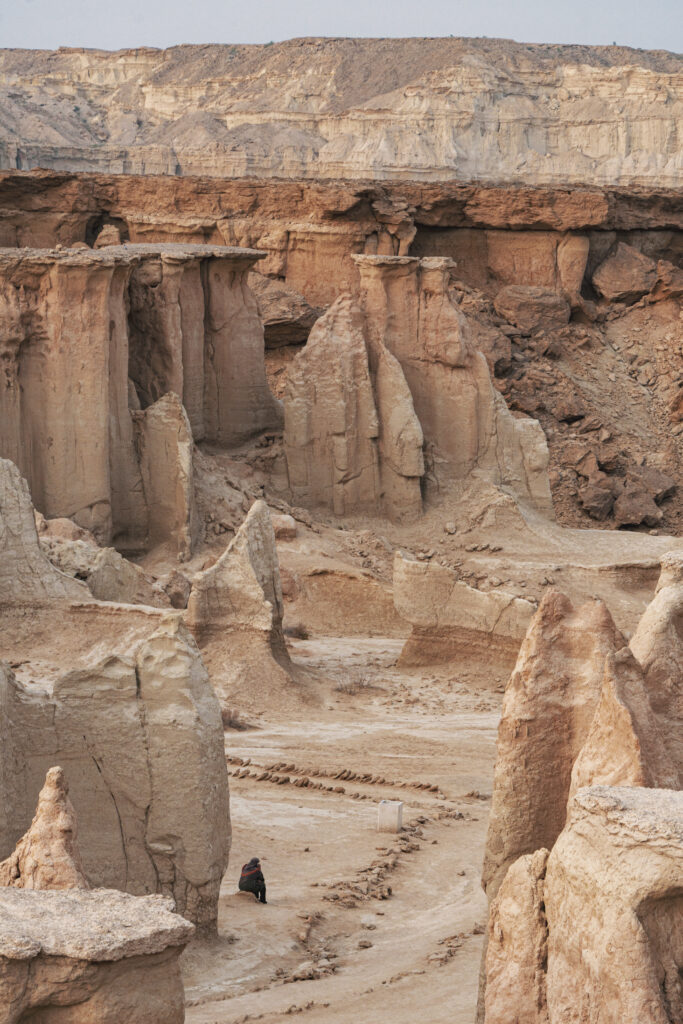
Stars Valley, Qeshm Island. Photo by Iran Guide.

Understanding Prices in Iran

Iran’s price system is notoriously confusing due to three coexisting units:

  1. The rial is the official currency with the currency code IRR. Almost all prices will be written in rial: price tags in the supermarket, at the ATM or on your receipt.
  2. The toman was used for centuries in Iran in everyday speech. The conversion is simple: 10 rial = 1 toman.
  3. The “new toman” was introduced in 2020 due to the ongoing inflation. The idea is to make numbers smaller again. To get the “new toman”, divide the old toman by 1,000: “scratch three zeros from old toman”.

Eventually, Iran will only use the “new” toman system. But for now, rial is used for written prices and the two toman systems in spoken language.

Remember: The easiest way is to remember what 1€ or 1$ roughly converts to:

1 EURO = 1,000,000 rial = 100,000 toman = 100 “new toman”

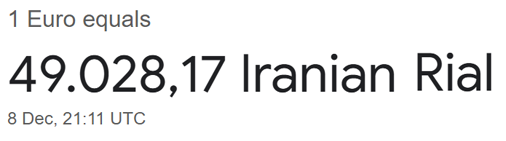
This conversion is outdated already; 1 EURO is now worth more than 1,000,000 rial. Hence, 100 “new toman” are now worth less than 1 EURO.

How Expensive is Traveling in Iran

Iran is one of the rare travel destinations where different budgets still lead to a rich, rewarding experience. Whether you’re travelling on just a few euros a day or seeking comfort and boutique stays, Iran offers exceptional value at every level.

For budget travellers, the country can be one of the cheapest destinations in Asia, thanks to incredibly low costs for food, transport, and accommodation — without compromising on hospitality or cultural depth. At the same time, Iran also provides excellent upscale options, from stylish boutique hotels to private guides, curated tours and comfortable domestic flights. And unlike many destinations, Iran has (almost) no tourist traps: here, spending more doesn’t mean getting scammed — it simply means getting more in terms of comfort, service, and experience.

  • Dorm bed in hostel 4–8 €
  • Eco-lodge / homestay 5–15 €
  • Budget hotel / guesthouse (double room) 10–20 €
  • Traditional guesthouse / boutique stay 15–35 €
  • Mid-range hotel (double room) 25–40 €
  • Street food (sandwich, soup) 0.50–1.50 €
  • Fast-food meal 2–4 €
  • Restaurant meal (mid-range) 4–10 €
  • Tea in teahouse 0.10–0.50 €
  • Coffee (café latte/espresso) 1–3 €
  • Bottle of water (1.5 L) 0.20–0.40 €
  • Pack of cigarettes 0.80–1.20 €
  • Taxi ride (5–10 km) 1–3 €
  • City bus / metro ticket 0.10–0.20 €
  • Intercity shared taxi (savari) 2–6 €
  • VIP long-distance bus 6–12 €
  • Domestic flight 30–60 €
  • Airport → Tehran taxi 5–10 €
  • Gasoline (per liter) ~0.04 €
  • Diesel (from truck drivers, per liter) 0.10–0.15 €
  • Simple motorcycle repair 1–3 €
  • Car wash 0.75–2 €
  • Bread (per piece) 0.10–0.20 €
  • 1 kg fruit (apples/grapes/bananas) 0.50–1.50 €
  • Chicken breast (1 kg) 2–3.5 €
  • Minced beef (1 kg) 3–5 €
  • 1 dozen eggs 0.80–1.50 €
  • Potatoes (1 kg) 0.20–0.40 €
  • Entrance to smaller sites and museums 0.50–2 €
  • Entrance to major sites 2–5 €
  • Entrance to UNESCO top-tier sites 5–15 €
  • Desert tour with driver (half-day) 25–40 €
  • Local city guide (per day) 25–50 €

Daily Budget in Iran

Travellers experience Iran in very different ways, depending on how much they choose to spend. From ultra-budget cyclists and backpackers to comfort-seekers and boutique-hotel lovers, the profiles below show how Iran can be enjoyed meaningfully at any budget. Note: budget estimates include daily expenses for transportation, accommodation, food; but exclude one-time expenses such as souvenirs, visa costs, or costly car repairs.

Budget

< 10€
per day

The Budget Traveller keeps daily costs low by camping, couchsurfing, and occasionally staying at cheap guesthouses. They either have their own transport or move around the country using buses or hitchhiking. This traveller rarely pays for guided tours and often chooses free outdoor attractions over ticketed ones. They buy groceries locally and cook themselves. When sampling the local cuisine, they choose small eateries over fancy restaurants. Despite the tight budget, they enjoy Iran’s hospitality, rich culture and vast landscapes while keeping travel minimalistic.

Medium

< 30€
per day

The Medium Spender prefers comfort at a low cost, choosing simple private rooms and reliable transport without overspending. They enjoy eating in cafés or restaurants when something looks good, without checking prices obsessively. Most intercity travel is by bus or the occasional domestic flight when the price is right. This traveller visits many attractions, occasionally joining group activities or cultural experiences. They balance comfort and budget, experiencing Iran richly without breaking the bank.

Upscale

< 75€
per day

The Upscale Traveller seeks a smooth, comfortable experience, staying in unique boutique or traditional-style hotels with high service standards. They enjoy private guides, desert or mountain tours, and curated day trips without worrying about cost. Domestic flights help them cover long distances quickly. Meals are enjoyed in quality restaurants or stylish cafés, often multiple times a day. This traveller appreciates convenience, flexibility, and comfort while exploring Iran’s cultural and natural highlights.

Iranian Travel Bank Cards

Iran is a largely cash-free society. Bank cards are accepted virtually everywhere: from supermarkets to corner stores, luxury restaurants to the lady selling food on the street, everyone carries a card reader. There are no minimum transaction fees for paying by card. Even if you only want to pay a few cents, it is commonly paid by card.

While cash is generally accepted in many places, there are a few downsides to using cash in Iran, which are summarised briefly here:

  • Forget about your change. Many vendors do not carry sufficient bills to give you the right change. It is usually you who will have to accept the loss.
  • Cash not accepted. There are places where cash is not accepted, for example in bakeries or some government offices.
  • Security. Your cash, especially when you carry big bundles of it, may attract unwanted attention and can get stolen. Money on your account remains safe as long as your PIN code remains secret.
  • Money exchange. Money exchangers often do not carry around enough bills. A travel card is connected to an account and money can be transferred to it; it makes exchange much easier and sometimes you even get a better rate.
  • Convenience. Using a card makes daily life a lot easier in Iran. Do it as the locals do and pay by card – and you can easily keep track of your expenses.

The following documents are required to get a card:

  • Passport copy
  • Address for delivery of the card (only takes a few days)
  • Top-up amount (how much you wish to load onto your card)

Official Exchange Rate

Source: google.com, Dec. 08 2025

Guide to Iranian Banknotes

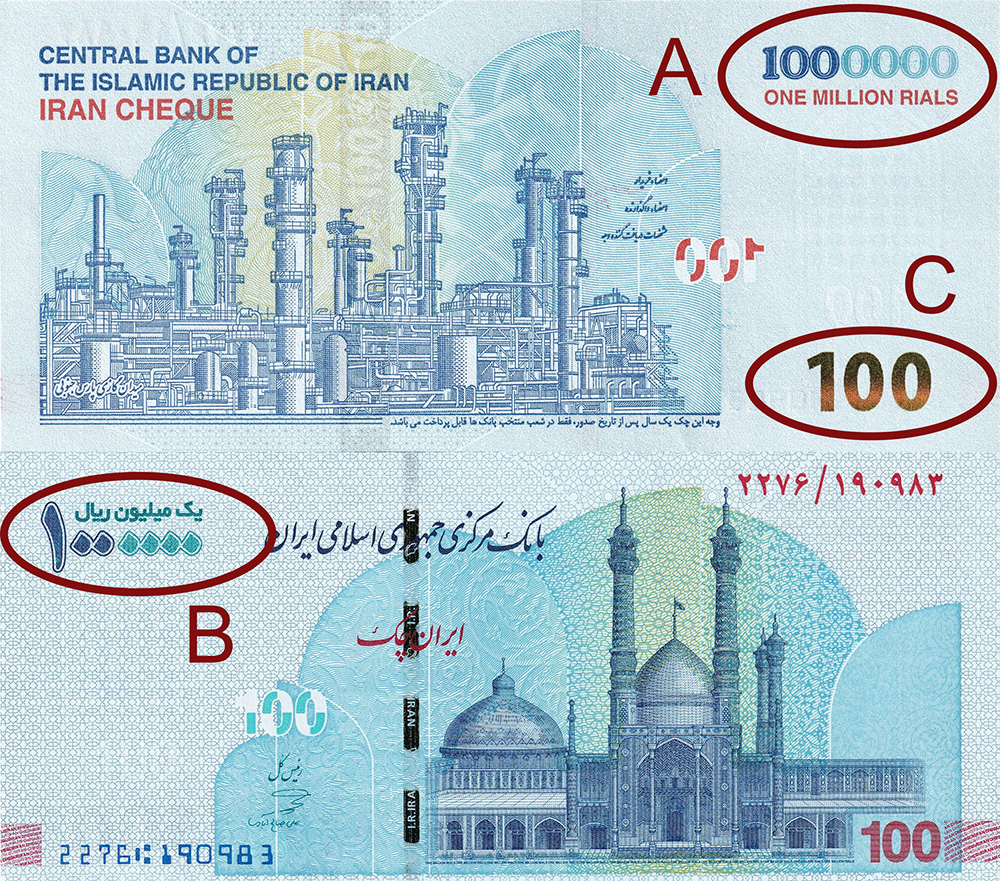
Let’s have a look at a new 1,000,000 rial bill:

  • A: in English: “1000000 one million rials
  • B: same as A, in Farsi: “۱۰۰۰۰۰۰ یک میلیون ریال”)
  • C: the “new” toman number: “100”

Attention: bills older than from 2020 do not include C: new toman value (see right column below).

In the following, I have included the newest and the second newest type of bills for each denomination. However, there are still a few special editions or older notes you may encounter sometimes. So don’t be surprised. And if you are into it – happy collecting!

2,000,000 Rials / 200 (thousand) Toman

New bill: Two men on horseback playing Chovgan / Naqsh-e Jahan-square in Isfahan

Old bill: Farsi script and floral and geometric patterns / Karoun 3 Dam

1,000,000 Rials / 100 (thousand) Toman

New bill: South Pars gas field / Masoumeh Shrine in Qom

Old bill: Farsi script and geometric patterns / Tachara-Palace in Persepolis

500,000 Rials / 50 (thousand) Toman

New bill: Damavand Mountain / Imam Reza Shrine in Mashhad

100,000 Rials / 10 (thousand) Toman

New bill: Tomb of Saadi in Shiraz / Ayatollah Khomeini

Old bill: Tomb of Saadi in Shiraz / Ayatollah Khomeini

50,000 Rials / 5 (thousand) Toman

New bill: Tomb of Hafez in Shiraz / Ayatollah Khomeini

Old bill: Entrance to Tehran University / Ayatollah Khomeini

20,000 Rials / 2 (thousand) Toman

New bill: Mausoleum of Poets in Tabriz / Ayatollah Khomeini

Old bill: Aghazadeh Mansion in Abarkooh (Yazd province) / Ayatollah Khomeini

10,000 Rials / 1 (thousand) Toman

New bill: Avicenna Mausoleum in Hamedan / Ayatollah Khomeini

Old bill: Tomb of Hafez in Shiraz / Ayatollah Khomeini

Read more Guides